25.11.2025
6th Regional Cybersecurity Conference
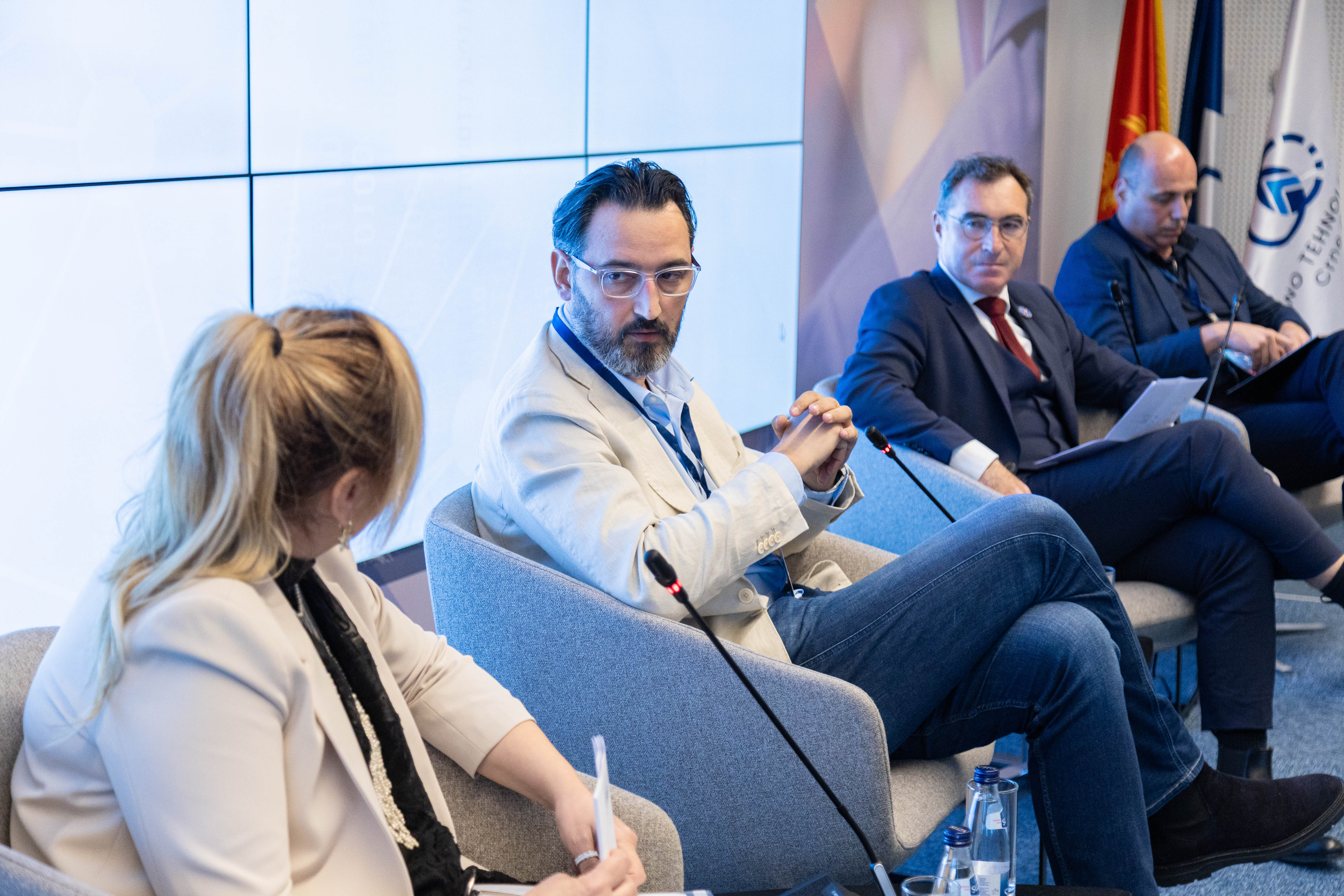
Last week, WB3C participated in the 6th Regional Cybersecurity Conference organized by the Montenegrin NGO Secure, contributing to one of the key discussions of this event: “The impact of AI on cybercrime and law enforcement.” The panel was moderated by our Senior Project Manager, Vanja Madzgalj MBE, and brought together perspectives from the public sector, private sector and the international community supporting capacity building in the region.
A central issue emerged throughout the conversation: as organizations increasingly automate their defences, what happens to the human experts? With AI performing threat analysis, pattern detection and other complex tasks, the role of cybersecurity professionals is not disappearing, it is changing. Their new value lies in oversight, critical judgment, strategic decision-making and the ability to understand and manage AI-enabled systems. This raises another pressing question: while organizations are encouraged to adopt AI, how can they protect their sensitive data from the very risks that AI tools themselves may introduce?
The discussion underscored that AI is transforming both sides of the cyber battlefield. Criminals are using it to scale attacks with unprecedented sophistication, while defenders are leveraging it to detect, analyse and respond to threats faster than ever before. This race for the upper hand demands continuous training and upskilling on all fronts: across government, critical infrastructure, law enforcement and society at large.
Panelists Gilles Schwoerer (WB3C), Bojan Miranović (Police Directorate of Montenegro) and Ivan Stankovic (Čikom) highlighted what this means in practice: how law enforcement handles AI-driven cybercrime, the types of training and support frontline teams need, the institutions most at risk and why cross-border and cross-institution cooperation is becoming indispensable.
For WB3C, these insights reinforce the importance of our mission. As AI accelerates both opportunity and risk, the Western Balkans will need strong skills, trusted partnerships and resilient institutions to stay ahead of emerging threats. WB3C remains committed to supporting that effort across the region.

25.11.2025
Montenegro Police Academy – Graduation Ceremony of the 17th Generation
Today, our colleagues Gilles Schwoerer, head of WB3C and Yannick Casse, cybercrime trainer, attended the graduation ceremony of the 17th generation of cadets at the Police Academy in Danilovgrad. What an emotional event filled with pride! This ceremony marked the formal completion of training for a new cohort who will now enter operational roles within the police service.
WB3C maintains an active partnership with the Police Academy focused on developing practical digital investigation skills. So far, we have delivered two OSINT training cycles for their cadets, with a third planned for December. These trainings, led by our in-house cybercrime trainers Lt. Y. Casse and Brigadier Chief Cyril C., introduce structured methods for identifying, collecting and preserving open-source information for lawful use in investigations. Strengthening digital competencies is crucial for contemporary policing and we look forward to continuing this work with the upcoming training group.
Congratulations to the graduating cadets!
21.11.2025
A Look Back at a Productive Workshop on Cyber Diplomacy in Podgorica
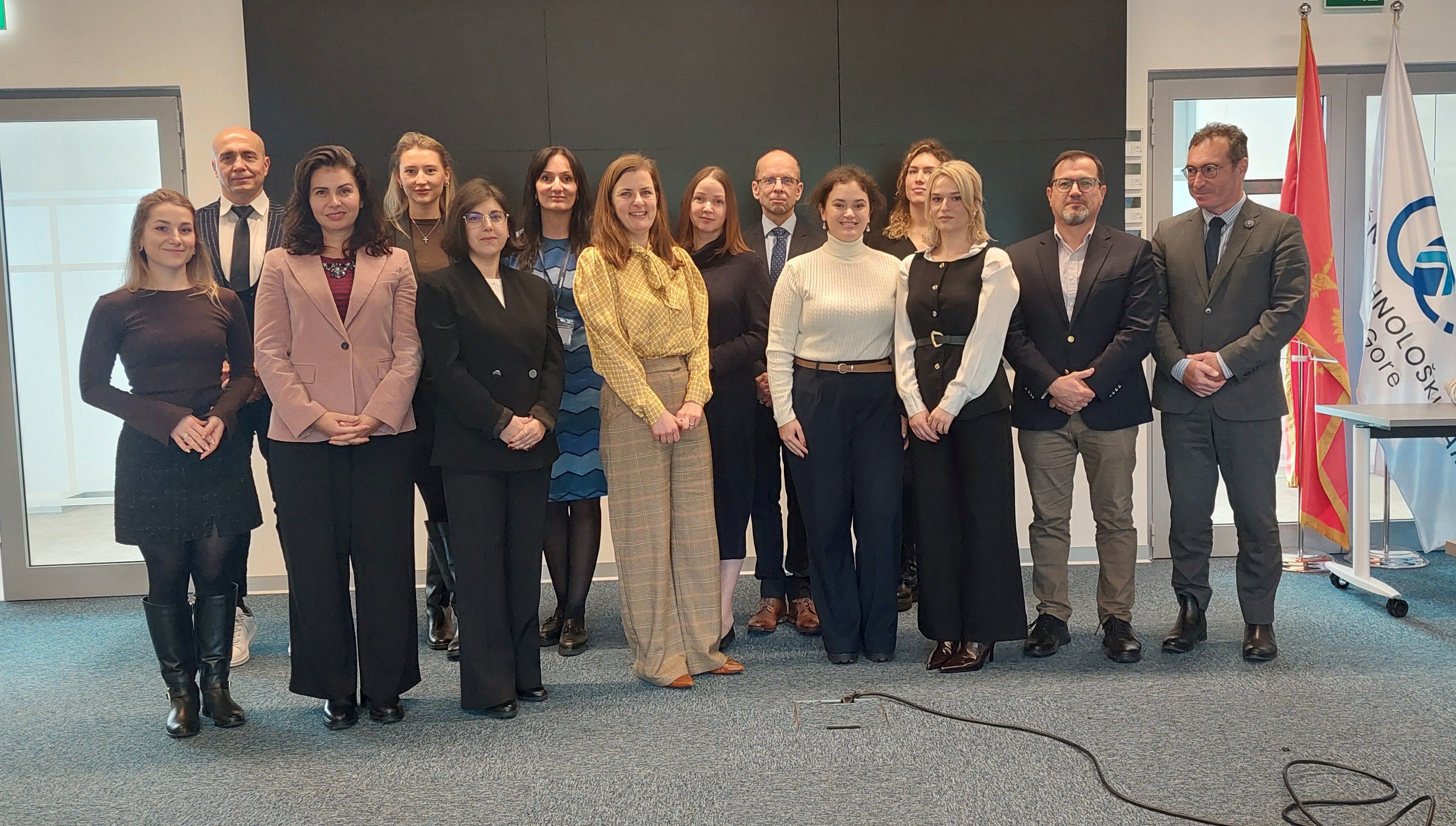
Last week, on 20-21 November, DCAF and the Western Balkans Cyber Capacity Centre (WB3C) had the pleasure of hosting the workshop "Responsible State Behaviour in Cyberspace: International Norms, Venues and Processes."
It was an engaging two days filled with insightful discussions among professionals coming from foreign ministries in the Western Balkans and Moldova.
The seminar covered the following topics:
✔️ Operationalizing UN norms from the GGE and OEWG into national strategies.
✔️ Navigating the complex landscape of cyber diplomacy across bilateral and multilateral venues.
✔️ A hands-on exercise on national coordination and international cooperation during a cyber crisis.
These conversations are vital for building a more stable and secure cyberspace, and the collaboration seen in Podgorica is a testament to the shared commitment in the region and beyond. The seminar was also attended by our project manager Maja Miranovic, as part of her professional development. WB3C is committed to empowering women in cyber.
The seminar ended with closing remarks from Franziska Klopfer and Gilles Schwoerer, stressing that the consistent implementation of these norms is the foundation of international stability in cyberspace.
19.11.2025
WB3C Concludes Certified DPO Training
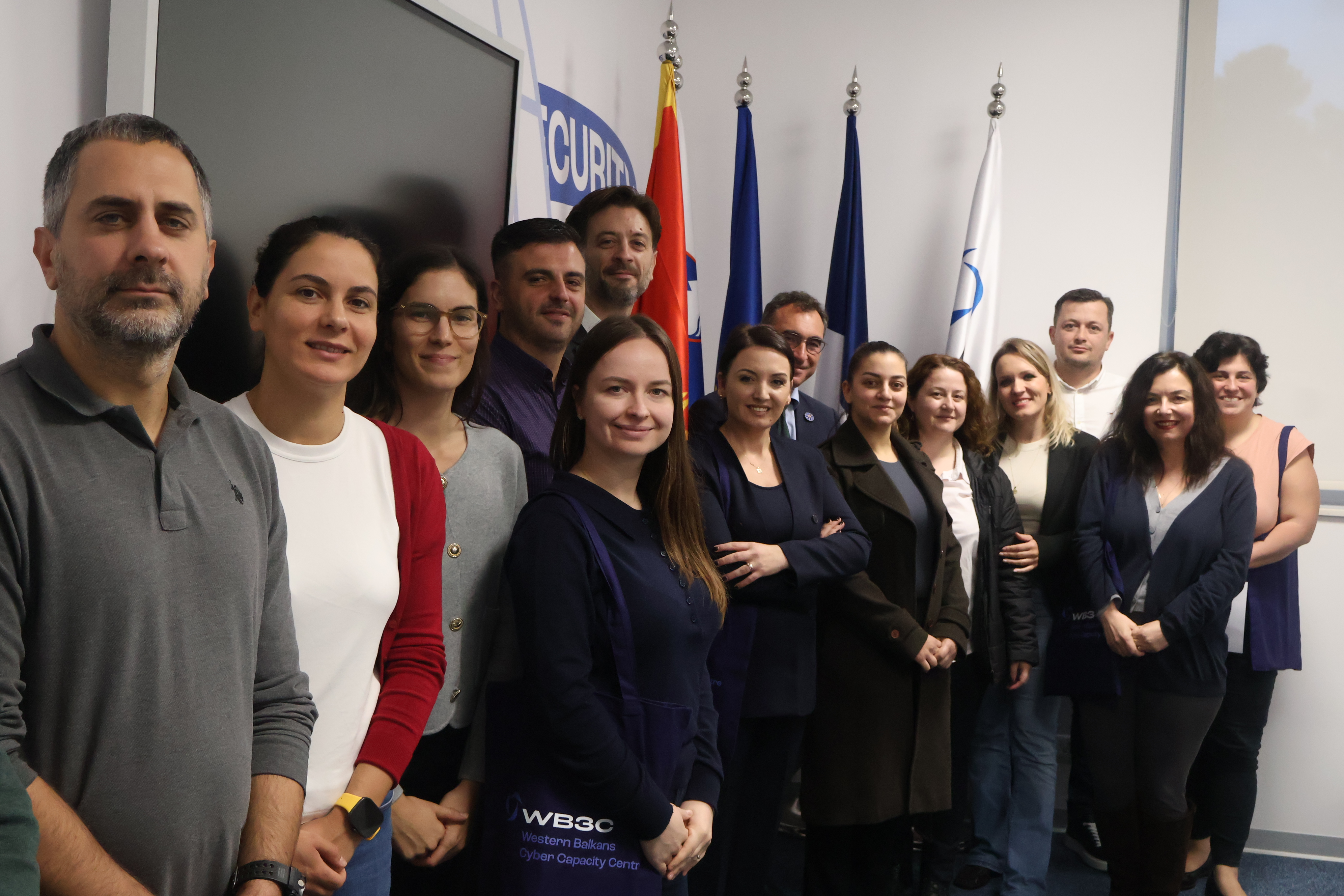
This week, the Western Balkans Cyber Capacity Centre (WB3C) successfully concluded its first regional Certified Data Protection Officer training in Podgorica, bringing together 12 public servants, two from each of the six Western Balkans economies.
The intensive three-day workshop provided advanced, practical training in data protection governance, moving from theory to application through realistic public-sector simulations. Participants engaged in hands-on exercises, including Data Protection Impact Assessments (DPIAs) and data breach response drills, using tailored scenarios to bridge the gap between legal frameworks and daily operational challenges.
Under the leadership of Gilles Schwoerer, WB3C is committed to advancing the region's cyber resilience and EU alignment through such specialized capacity-building initiatives. This initiative directly supports the region's efforts to align with EU data protection standards and regulations (GDPR), a key step in the digital transformation and EU integration agenda. By fostering a network of certified professionals across the WB6, we are strengthening the foundational capabilities necessary for cross-border data flows and future digital market integration.
We extend our appreciation to the dedicated national coordinators, our expert trainers Stefano Leucci, Stella Manga Chesnay and Blerta Xhako, and all participants for their commitment to advancing data protection standards and regional cooperation.

10.11.2025
The first generation of cybersecurity diploma course students are starting a one-year journey!
The first cohort of 7 final-year and master’s students in ICT have just begun the preparatory course of our University Diploma in Cybersecurity, delivered by the Western Balkans Cyber Capacity Centre (WB3C) in partnership with the Université de Technologie de Troyes (UTT), France, under the leadership of professor Reza Elgalai.
This two-week preparation helps students strengthen their foundations so they can follow the full program confidently and succeed in final exams. The second preparatory course will take place in December with another 13 students, after which UTT will select the top 10 candidates to continue with the full diploma course in February 2026.
The program itself is unique in the region. It’s an off-campus study with UTT professors, leading to a 60-ECTS diploma in cybersecurity. With UTT’s recognition of prior learning (120 ECTS from earlier studies), students can earn a parallel EU-recognized professional Bachelor’s degree - a true bridge into the European cyber workforce.
It’s also highly practical. Students learn by doing through lectures, labs, case studies and Capture-the-Flag exercises - building skills that will allow them to step directly into roles such as:
🔹 Security Administrator
🔹 SOC Analyst
🔹 Junior Penetration Tester
🔹 Digital Forensics Technician
🔹 Cybersecurity Auditor
At the same time, WB3C is in discussions with the University of Montenegro exploring how we call collaborate on our cybersecurity initiatives and provide a sustainable academic pathway for the next generation of cyber professionals. The momentum is here. These two programs mark a turning point for Montenegro’s cybersecurity education landscape - building a talent pipeline for the region’s most in-demand cyber roles.
08.11.2025
Day 2 of the Workshop for Young Women in Cybersecurity
Talent is not an issue - we need more opportunity, visibility and structured support.
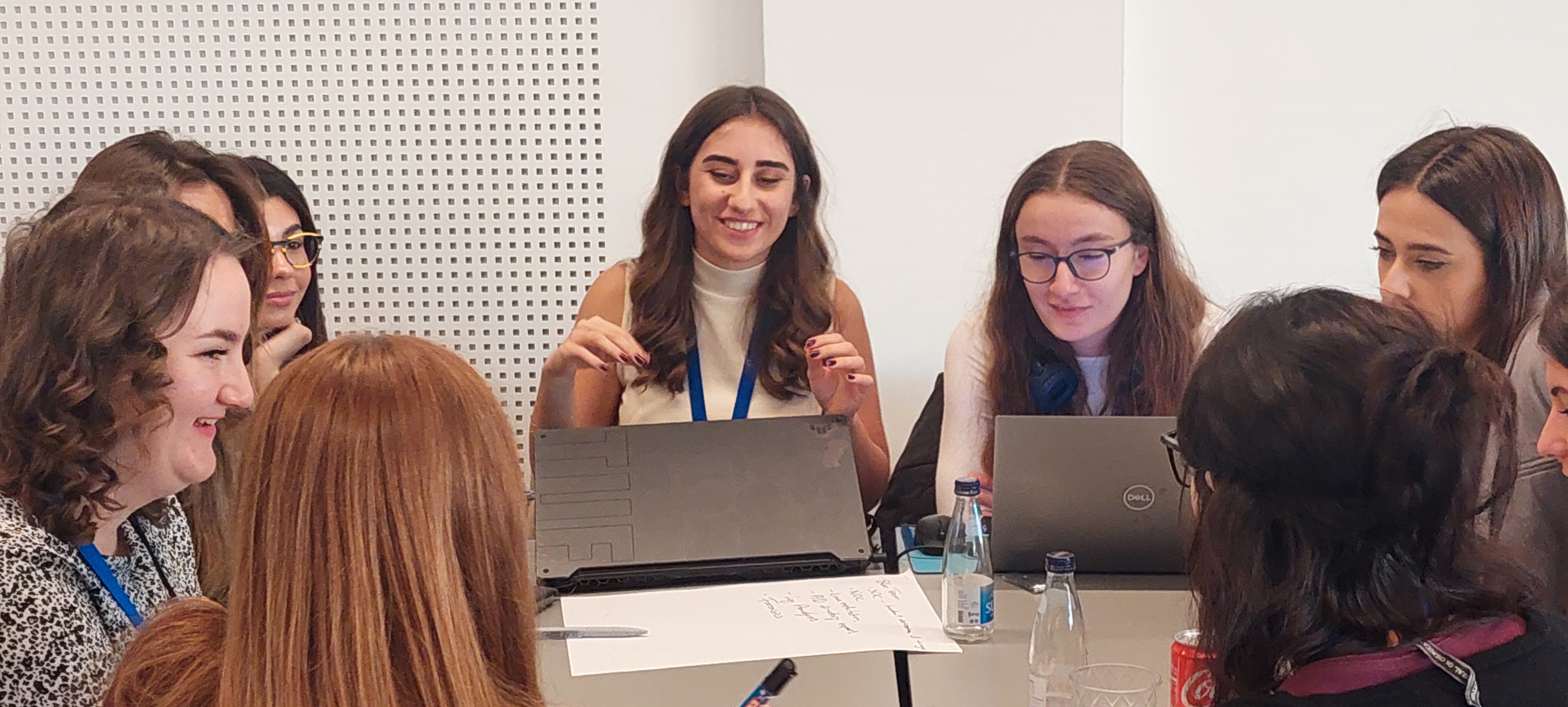
Seeing a room full of 70 ambitious young women - many already studying or working in ICT - taking on cybersecurity challenges with confidence and creativity is a reminder of the immense potential that exists right here in the Western Balkans.
Their presentations following the hands-on exercises made one thing clear: talent is not the issue - visibility and opportunity are.
Across the region, women remain one of the most under-utilized resources for innovation, growth and a balanced digital economy.
While global figures show women make up only around 22–24% of the cybersecurity workforce, the gap grows wider at the top - far fewer women reach leadership or C-level roles. Many still face a glass ceiling, subtle bias or the weight of imposter syndrome in male-dominated environments. Supporting young women in developing confidence, assertiveness, and leadership skills is therefore as essential as technical training itself.
Cybersecurity, at its core, is about resilience and adaptability. To build that resilience, our teams must reflect the diversity of the societies they defend. Investing in women in cyber is not a matter of fairness alone - it’s a matter of strategic foresight for the region’s stability and competitiveness.
As these young women step forward, they challenge old assumptions, redefine expertise and show that the future of cybersecurity in the Western Balkans can be both strong and inclusive.
We deeply appreciate our partnership with DCAF and FCDO for enabling WB3C to be part of such an important initiative.

07.11.2025
WB3C joins UK's regional CybHER initiative empowering women and girls for cyber careers
We are proud to be part of the regional CybHER initiative by the British Council, designed to empower girls and women across the Western Balkans to pursue and thrive in cyber careers. For the WB3C, CybHER is not only a regional effort we support, but also a concrete opportunity to invest in our own people and create space for their professional development.
As part of this, WB3C took part in two CybHER components:
1️⃣ A leadership program for early-career women in cybersecurity.
2️⃣ A workshop on gender-sensitive HR policies for cybersecurity organizations.
1. Leadership skills for early-career women in cyber
Our colleague Vanja Radović is representing the WB3C in the CybHER leadership track for young women in cybersecurity. This program is designed to help participants gain both the mindset and the skills needed to grow and lead in a still male-dominated industry. Over the course of the program, participants will:
💡 Build authentic leadership skills by exploring their personal values, leadership styles and emotional intelligence.
💡 Discover diverse cybersecurity career paths and map concrete options for their own development.
💡 Learn practical strategies to navigate stereotypes, bias and workplace barriers with confidence.
💡 Strengthen networking and collaboration skills to build a reliable support system in the sector.
💡 Develop a personal action plan to apply what they learn in their daily work.
We are especially glad that Vanja will learn from experienced regional leaders such as Larisa Halilovic, an international leadership expert, and Andreja Mihailović, PhD, President of Women4Cyber Montenegro, whose guidance connects technical careers with the human skills needed for leadership.
2. Gender-sensitive HR policies in cybersecurity organisations
In parallel, WB3C also joined the CybHER workshop on gender-sensitive HR policies in cybersecurity organizations, focusing on how organizational systems can either open doors for women - or quietly keep them closed. This component, was followed by our colleague Vanja Madzgalj, responsible for strategic communications and with substantive experience in gender mainstreaming, in order to:
💡 Exchange experiences and good practices between companies on inclusive and fair HR approaches.
💡 Look at domestic and international trends in gender-sensitive and inclusive HR in tech and cybersecurity.
💡 Examine how bias, discrimination, the glass ceiling and everyday prejudices show up in recruitment, promotion and leadership opportunities.
💡 Explore practical ways to improve the full HR cycle: from inclusive job descriptions and selection processes, to advancement, leadership roles and supportive workplace culture.
💡 Discuss mechanisms for safety and confidential reporting, and how policies can better protect and empower staff who experience harassment or discrimination.
The workshop concluded with self-assessment of existing HR practices, individual commitments for change and first steps towards mentoring and peer support, so that policy discussions can translate into everyday practice.
At the Western Balkans Cyber Capacity Centre (WB3C), we believe that real change happens when we work on both people and systems. By empowering our own female colleagues through programs like CybHER, and by strengthening HR and organizational practices that support them, we are investing in a cybersecurity community where women can enter, stay, grow and lead.
06.11.2025
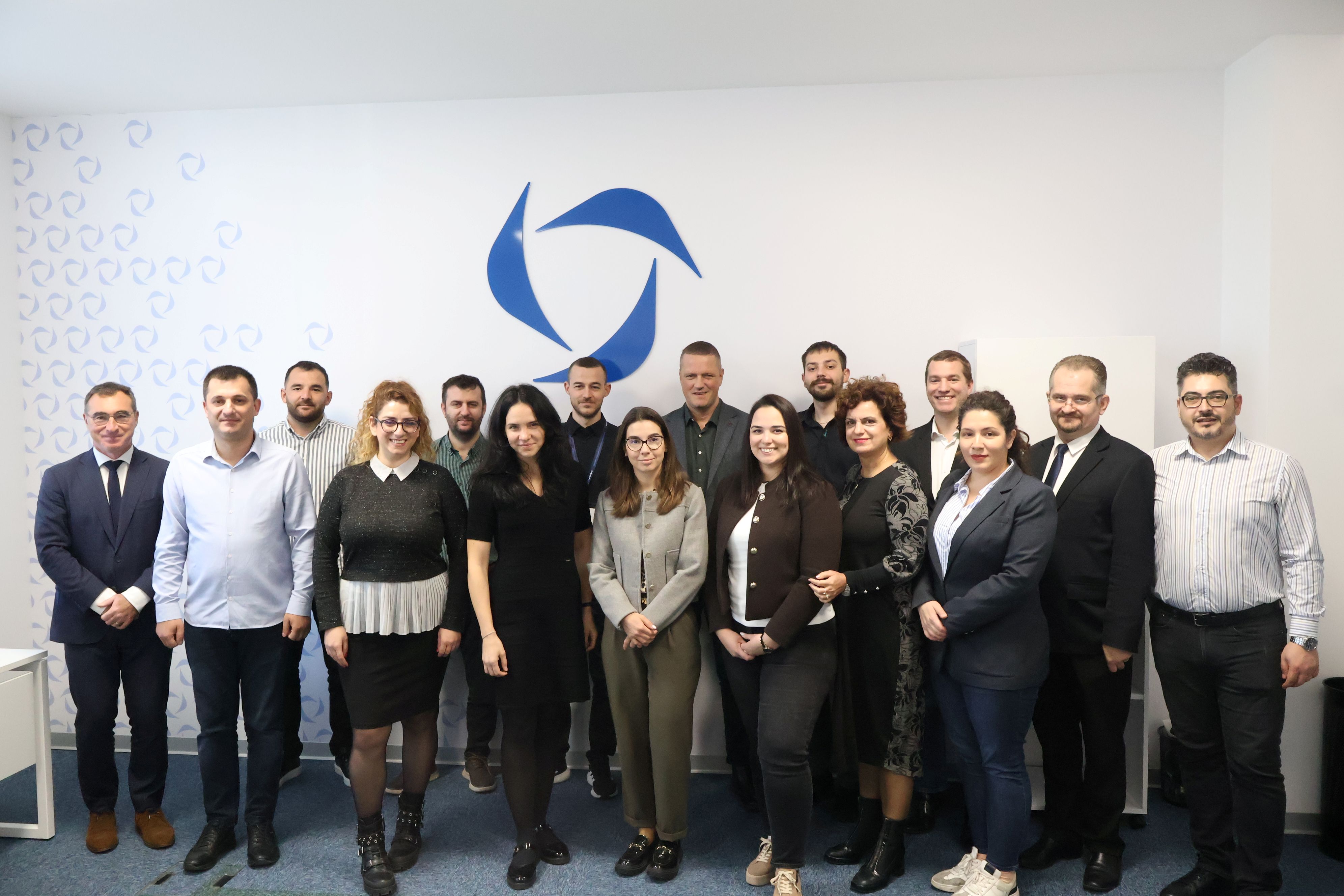
Certificate Ceremony for Cybersecurity Awareness Program
Another demanding but successful three-day Cybersecurity Awareness Program is in the books!
From 3-6 November, we rolled up our sleeves with civil servants from across the Western Balkans, equipping them with practical tools to lead cybersecurity awareness and build national frameworks within their own administrations, particularly in relation to NIS2 implementation.
This collaborative workshop with URSIV - Urad Vlade Republike Slovenije za informacijsko varnost focused on the skills of:
🔒 Building & evaluating internal cybersecurity awareness programs from the ground up.
🤝 Establishing a national Coordinated Vulnerability Disclosure (CVD) ecosystem.
📜 Translating the NIS2 Directive into actionable national policy.
The session wrapped up with a certificate ceremony. We were pleased to have the awards presented by Gilles Schwoerer, Head of WB3C, Igor Kovač from URSIV and Alina U. from our Romanian training team.
Massive thanks to the fantastic team of experts from the Romanian National Cyber Security Directorate - Alina U., Diana-Alexandra Morea, Mihai Marica, Cristian Driga and Daniel Iliescu - for sharing their hands-on experience and guiding the participants through these complex topics.
Big thanks to our dedicated civil servants for their continued engagement in learning and improving cyber capabilities of our administrations.
05.11.2025
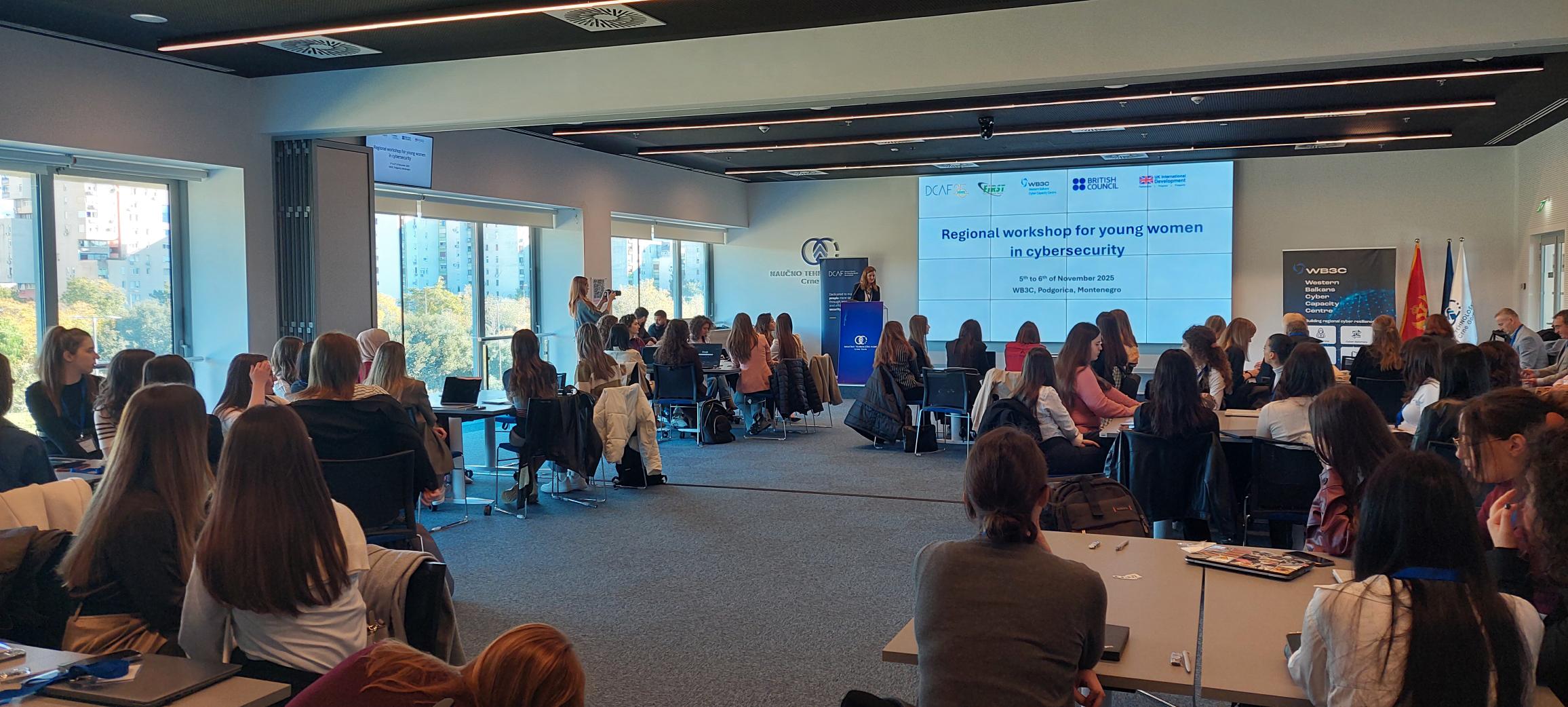
Regional Workshop for Young Women Entering Cybersecurity Workforce
This week, the Western Balkans Cyber Capacity Center (WB3C) is buzzing with energy and ambition! In a powerful collaboration with our partners DCAF - Geneva Centre for Security Sector Governance, FIRST, Foreign, Commonwealth and Development Office and the British Council, WB3C is hosting a two-day regional workshop dedicated to 70 inspiring young women in ICT entering the cybersecurity workforce from across the Western Balkans. The journey began with inspiring opening remarks that set the tone for the days ahead given by:
- Her Majesty's Ambassador Dawn McKen of the British Embassy Montenegro
- Béatrice Godefroy, Deputy Director DCAF, who address the participants online from Geneva,
- Gilles Schwoerer, Head of WB3C
- Nina Lukic, Senior Programme Manager at the British Council
The event's host is Franziska Klopfer, DCAF Programme Director for Western Balkans and the mastermind behind the event.
These 70 ambitious young women are members of the British Council's #CybHER project network, and for the next two days, they are diving deep into the world of cybersecurity. Why does this matter?
Because the digital frontier needs their talent, perspective and skill. Cybersecurity isn't just about code and firewalls, it's about building a safer, more resilient world for everyone. And to do that effectively, we need diverse teams that reflect the society they protect.
Over these two days, the agenda is packed with action and inspiration:
✨ A motivating keynote from Mona Elisabeth Østvang of FIRST.
✨ Hands-on "Capture the Flag" challenges to test their technical skills.
✨ Inspirational presentations and testimonials from female cyber experts, showing them the incredible career paths that lie ahead.
✨ A panel on the "Meaningful Participation of Women in the Cybersecurity Workforce," turning discussion into action.
This is more than a workshop - it's a catalyst. It's about building a regional network of support, sparking curiosity and empowering the next generation of cyber defenders. These young women are not just the future; they are the urgently needed present of cybersecurity. Western Balkans needs these women leaders across technical and non-technical fields of cybersecurity.